 The Digital Scriptorium is a collection of medieval & renaissance handwriting that can be magnified very large. I only discovered it, and have much exploring to do. By the way, this initial is not from the site but it's representative.
Showing posts with label history. Show all posts
Showing posts with label history. Show all posts
Monday, March 23, 2009
Digital Scriptorium
The Digital Scriptorium is a collection of medieval & renaissance handwriting that can be magnified very large. I only discovered it, and have much exploring to do. By the way, this initial is not from the site but it's representative.

Sunday, March 01, 2009
Napoleon's Scientific Expedition to Egypt

Who knew? Napoleon's engineers and artists studied ruins of ancient Egypt --- discovered the Rosetta Stone -- and introduced Europe to the mysteries of this ancient world. This was an exhibit at the Linda Hall Library in Kansas City.
Illustration: The Zodiac of Dendera is a large carved stone slab showing the constellations of the zodiac. It was discovered in a small chapel at Dendera by Vivant Denon in 1799. Denon made a drawing, and subsequently another was made by Prosper Jollois and Edouard Devilliers. In 1822, the zodiac was wrested from its chapel ceiling and taken to Paris, where it became an object of intense interest to astronomers, who hoped to use the star positions to date the artifact.
Sunday, May 25, 2008
Byzantine icons

The Byzantine icons seems the most holy and sacred. This is from St. Catherine's monastery in Sinai.
Pantages Theatre Lights

This gives a small glimpse of the grandeur of this former deco movie palace.
Monday, October 29, 2007
Franz Liszt
.jpg) Portrait of Franz Liszt painted by Henri Lehmann in 1839.
Portrait of Franz Liszt painted by Henri Lehmann in 1839.Franz Liszt had an incredible life, spanning much of the 19th century. He was the equivalent of a rock star in his youth, when he traveled through Europe giving piano recitals. Liszt had a brilliant, charismatic personality, and yet he was a charming and nice man: a true romantic. There is too much to say about him, so I highly recommend the biography by Alan Walker. It is three volumes, but they are page-turners.
Thursday, September 13, 2007
Annie Oakley

From Wikipedia:
(August 13, 1860 – November 3, 1926) b. Phoebe Ann Mosey was an American sharpshooter and exhibition shooter. Oakley's amazing talent and luck led to a starring role in Buffalo Bill's Wild West show, which propelled her to become the first American female superstar. Using a .22 caliber rifle at 90 feet (27 m), Oakley could split a playing card edge-on and put five or six more holes in it before it touched the ground.
...
She also engaged in extensive, albeit quiet, philanthropy for women's rights and other causes, including the support of specific young women that she knew...After her death on Nov. 3, 1926 at age 66, it was discovered that her entire fortune had been spent on her charities.
Friday, August 24, 2007
100 years ago

This fantastic site, http://www.shorpy.com/, has vintage photos of the USA early this century. The images are hi-res and perfect quality. It also lists the photographer and/or collection the photo is from. This one is called "Fifth Avenue Sunday", ca. 1913.
Tuesday, May 15, 2007
Nikola Tesla

From Wikipedia:
Nikola Tesla (10 July 1856 - 7 January 1943) was a world-renowned inventor, physicist, mechanical engineer and electrical engineer. He was born an ethnic Serb subject of the Austrian Empire, and later became an American citizen. Tesla is best known for his many revolutionary contributions to the discipline of electricity and magnetism in the late 19th and early 20th century.
The Wikipedia article is long and I haven't read all of it. But I will. Tesla was brilliant, eccentric, and strange. In 1943 the U.S. Supreme Court credited him with the invention of radio. Most people think Marconi invented it.
Tuesday, April 24, 2007
Ryugyong Hotel in Pyongyang
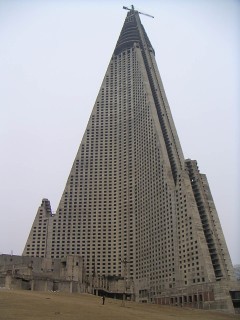
From Isaac Mao's caption:
Under the personality cult of leaders Kim Jong-il and his father Kim Il-sung, North Korea has become fiercely isolationist, nationalistic, and totalitarian. Despite being one of the planet's poorest countries, the communist state looks for any achievement to boost itself in eyes of the world. Its people know little or nothing of other nations except for the fact that Democratic People's Republic of Korea (DPRK) is vastly superior.
The DPRK is also one of the world's most secretive nations. For a North Korean, contact with a foreigner can land one in jail… or worse. But there is one embarrassing secret that is hard for the government to hide, literally. It's the Ryugyong Hotel in the Potong District of North Korea's capital city of Pyongyang. It's difficult to hide because it's a massive, 105-story structure which dominates the city's skyline. It's an embarrassment because it's a complete engineering failure… its empty, dilapidated husk lurks over the capital, mocking the citizens of the proud country.
The hotel's story begins in 1987, when the North Korean government began construction at an estimated cost of $750 million, or 2% of the country's gross domestic product (GDP). By comparison, 2% of the United States' GDP would be about $220 billion. Construction of the hotel was a cold war response to other massive skyscrapers in Asia, most notably South Korea's towering Stamford Hotel in Singapore. The North Koreans expected the project to bring in western investors as a first move into their nation. Investors were told to expect little oversight, and assured that casinos, nightclubs and lounges could be added. The North Korean government was so proud of the project that they added it to their official city maps before the project was even started, and they issued postage stamps touting the hotel before it was even half-finished.
The Ryugyong or "Capital of Willows" Hotel stands 1,083 feet tall, and it was planned to have 3,000 rooms and seven revolving restaurants. It has a total of 3.9 million square feet of floor space. The hotel would be the tallest hotel and seventh largest building in the world if it were finished. It would also have been the first building with over one hundred floors outside of New York or Chicago.
The first event scheduled to be held at the hotel was June 1989's World Festival of Youth and Students. The hotel was nowhere near ready for that event. Its construction was plagued with problems, and after five years construction completely ground to a halt due to a shortage of everything… especially funding and electricity. Work on the hotel has never resumed; the project was abandoned, leaving a lonely construction crane perched on its peak.
Pyongyang skyline, showing the Ryugyong Hotel on the top right.The shell of the building is complete but it has not been certified as safe for occupancy. There are no windows, fixtures, or fittings. The extremely poor quality concrete used in its construction has left the building sagging to such a great degree that the structure can never be finished without a massive overhaul.
The North Korean government is still looking for foreign investment, hopefully around $300 million. It's going to be hard to find such an investor considering the DPRK has such a tight stranglehold on visitors coming to their nation. The DPRK only allows about 130,000 tourists in an entire year, and almost none of them come to Pyongyang. To make matters worse, the nation appears to be in a never-ending drought and famine cycle that is not conducive for the operation of a five-star hotel.
Today, few North Koreans are willing to discuss the hotel with outsiders. The hotel, which was once found on city maps before the construction even began, has now been completely stricken from the official maps. Tour guides usually claim not to know where it is. Either a majority of the country is in a state of denial about the whole thing, or they avoid it.
Wednesday, April 11, 2007
Hotel Ukraine, Moscow

Photo: www.knifethrower.com
This is one of the seven sisters Stalinist buildings in Moscow.
From the site, www.gather.com:
Moscow's Seven Sisters are an architectural legacy of the most ambitious building program ever conceived. They were built at the orders of Jozef Stalin. These towers were built for the glorification of the Soviet State after WWII. The sisters were intended to rival the USA’s skyscrapers that had gone up in the 1930's. Each Sister was designed according to Stalin’s personal specifications and wishes. The architectural beauties are constructed in what is known as a ‘wedding-cake’ style, that concentrates the eye's focus toward the central tower. Stalin mandated that each and every one be given a spire, to differentiate them from their American counterparts. These huge buildings are distinctive in their design as well as their history.
Moscow's Seven Sisters (this one wasn't built)
 This is Chechulin's draft for Zaryadye skyscraper from wikipedia's article on "Seven Sisters Moscow".
 The Seven Sisters (called высотки, vysotki, the summits in Russian) are seven Stalinist skyscrapers in Moscow, Russia. They were built 1947-1953 in an elaborate combination of Russian Baroque and Gothic styles, and the early twentieth century technology of American skyscrapers. Similar buildings were built in Warsaw, Chelyabinsk, Kiev and Riga.
I find these buildings very spectacular and beautiful. At the same time, I guess they're kind of fascist.
Friday, March 30, 2007
For Annabelle

In E.A. Poe's handwriting. From site http://www.columbia.edu/acis/textarchive/rare/76.html/
Tuesday, March 27, 2007
Prague Alleyway

This is Prague, where Franz Kafka lived. Admittedly, Kafka is too depressing to actually read. The last thing I read was "The Metamorphosis" and it was the saddest thing ever. Kafka himself was a nice person, very charming and sweet. Unfortunately he had an insidious attachment to an oafish father whose approval he couldn't get. And he knew it. But it allowed him to define modern paranoia and become immortal.
Friday, March 23, 2007
Harry Houdini


I don't know much about Harry Houdini (Erich Weiss) but he's in the news today. His grand-nephew wants to exhume his body from its tomb in Queens to see if he was poisoned by spiritualist enemies in 1926. He spent a lot of time debunking the spiritualists and they hated him.
Thursday, March 22, 2007
Beverly Park Kiddieland

I used to visit this amusement park as a child. It's now the Beverly Center.
This description is from a site about rollercoasters: http://www.rcdb.com/ph1093.htm
The following list of attractions is thanks to Abraham M. Rudy who visited the park countless times from the late 1950s to the closing of the park.
* Train - that more or less circled a portion of the Park (individual "locomotive" type yellow and black cars that sat 2 to 3). The train ride had a "pay off" (a short and mild roller coaster-ish type ending that had you nearly running down a mannequin dressed as a engineer that swung out of harms way at the last minute).
* Autopia - Mini cars in bright colors that took a winding course around a portion of the Park but without any real control.
* Carousel - Parker Carousel #316.
* Boat ride - A very narrow boat ride that wound through a simple FantasyLand that was available for birthday parties. The area remained open for Birthdays through park's closing, but the boat ride ceased operating some years before.
* Pony Rides - A stable of sorts was West of the Park, same side of the street, sharing the parking lot to the West, around where the Hard Rock Café is today. The Pony Rides (nearly identical to those offered at the Griffith Park pony rides today) were open on the weekends, offered fast, medium and slow horses that would do two laps around a track of sorts (white wooden fences separated the concentric circles of track . . . innermost for slow, middle for medium, and the outside track for the fast horses). They gave you a short whip or crop for fast. (Editor's note: Ponyland was adjacent to Beverly Park, but was not owned by David Bradley.)
* Ferris Wheel - There was a Ferris Wheel right next to the ticket booth, with its back to LaCienega and circling E to W or W to E (depending on the direction). The cars was not enclosed, a simple bench seat with a rail in front of you.
* Fun House - A "Fun House" (mobile as opposed to walk through .. . 2 riders in a car, side by side) that came with it's own legend (or urban legend) -- this may actually have been confirmed -- about a famous dead body being used as one of the props. The old Long Beach Pike fun house may share this story . . . I'm no sure which, if any, is actually the proud owner of the corpse.
* Carousel - A small kiddie carousel with roundish fishes that 1 or 2 very small children could sit in. I don't recall if the fish went up and down or simply around.
* Food - A Hot Dog stand and the best roasted peanuts in red and white stripped I can ever recall tasting. Popcorn and cotton candy.
* Goldfish - At one time, goldfish in the little cement canal that carried the small boat. Whether for the taking or not, they were often taken.
* Grounds - The ground of the Park and of the parking lot was made up of gravel atop earth. Always clean, always raked, always light gray to off-white. And a chain link fence surrounding.
To see the entire pictured article: http://whimsicalwill.tripod.com/BeverlyPark1.html/
Saturday, March 03, 2007
Charles Altamont Doyle


The artist Charles Altamont Doyle was the father of Sir Arthur Conan Doyle. He was institutionalized in mental hospitals from middle age onward, although by today's standards he was not insane. Nor did he think he was insane, and tried to prove with his art that he wasn't. It didn't work. Basically, he was an alcoholic and depressed. He was a trained artist and his works are poignant and delicate. There's an interesting book called The Doyle Diary by Michael Baker (1978) that reproduces Charles Doyle's journal sketches from his time in Sunnyside mental institution in Scotland. If you think these works are strange, his brother Richard "Dicky" Doyle was a famous Victorian artist well known for his fairy illustrations. Years later, Arthur Conan Doyle publicized "fairy photographs" which he believed were real. By today's standards, these photographs are pretty fake looking. Even back then, they were debunked. My point being that the entire family (not just the one who was institutionalized) had a "thing" for fairies.
St. Giles His Bells (unknown location).
Meditation, Self Portrait (V&A Museum, London). This watercolour comes from one of the sketchbooks used by the artist during his stay in the Royal Montrose Lunatic Asylum in Scotland. His son, the writer Sir Arthur Conan Doyle, organised an exhibition of the artist's work in London in 1924. http://www.vam.ac.uk/images/image/16458-popup.html
Wednesday, November 01, 2006
Henry Morton Stanley

I listened to an audiobook, Into Africa by Martin Dugard. First time I ever heard the real story of Stanley finding David Livingstone in central Africa. Livingstone was searching for the source of the Nile. He wouldn't leave Africa and died there. Stanley later returned to Africa and did a lot of exploration. [okay, it's more complicated than that.] This opens up a new area of interest for me. The explorers of Africa, South America, and South Pacific faced incredible dangers and illnesses. What made them go to these places and then conquer them?
Subscribe to:
Posts (Atom)

