Tuesday, April 24, 2007

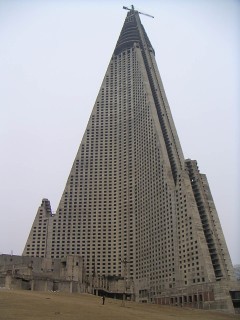
Ryugyong Hotel in Pyongyang


Ryugyong Hotel in Pyongyang, originally uploaded by Isaac Mao.

From Isaac Mao's caption:

Under the personality cult of leaders Kim Jong-il and his father Kim Il-sung, North Korea has become fiercely isolationist, nationalistic, and totalitarian. Despite being one of the planet's poorest countries, the communist state looks for any achievement to boost itself in eyes of the world. Its people know little or nothing of other nations except for the fact that Democratic People's Republic of Korea (DPRK) is vastly superior.

The DPRK is also one of the world's most secretive nations. For a North Korean, contact with a foreigner can land one in jail… or worse. But there is one embarrassing secret that is hard for the government to hide, literally. It's the Ryugyong Hotel in the Potong District of North Korea's capital city of Pyongyang. It's difficult to hide because it's a massive, 105-story structure which dominates the city's skyline. It's an embarrassment because it's a complete engineering failure… its empty, dilapidated husk lurks over the capital, mocking the citizens of the proud country.

The hotel's story begins in 1987, when the North Korean government began construction at an estimated cost of $750 million, or 2% of the country's gross domestic product (GDP). By comparison, 2% of the United States' GDP would be about $220 billion. Construction of the hotel was a cold war response to other massive skyscrapers in Asia, most notably South Korea's towering Stamford Hotel in Singapore. The North Koreans expected the project to bring in western investors as a first move into their nation. Investors were told to expect little oversight, and assured that casinos, nightclubs and lounges could be added. The North Korean government was so proud of the project that they added it to their official city maps before the project was even started, and they issued postage stamps touting the hotel before it was even half-finished.

The Ryugyong or "Capital of Willows" Hotel stands 1,083 feet tall, and it was planned to have 3,000 rooms and seven revolving restaurants. It has a total of 3.9 million square feet of floor space. The hotel would be the tallest hotel and seventh largest building in the world if it were finished. It would also have been the first building with over one hundred floors outside of New York or Chicago.

The first event scheduled to be held at the hotel was June 1989's World Festival of Youth and Students. The hotel was nowhere near ready for that event. Its construction was plagued with problems, and after five years construction completely ground to a halt due to a shortage of everything… especially funding and electricity. Work on the hotel has never resumed; the project was abandoned, leaving a lonely construction crane perched on its peak.

Pyongyang skyline, showing the Ryugyong Hotel on the top right.The shell of the building is complete but it has not been certified as safe for occupancy. There are no windows, fixtures, or fittings. The extremely poor quality concrete used in its construction has left the building sagging to such a great degree that the structure can never be finished without a massive overhaul.

The North Korean government is still looking for foreign investment, hopefully around $300 million. It's going to be hard to find such an investor considering the DPRK has such a tight stranglehold on visitors coming to their nation. The DPRK only allows about 130,000 tourists in an entire year, and almost none of them come to Pyongyang. To make matters worse, the nation appears to be in a never-ending drought and famine cycle that is not conducive for the operation of a five-star hotel.

Today, few North Koreans are willing to discuss the hotel with outsiders. The hotel, which was once found on city maps before the construction even began, has now been completely stricken from the official maps. Tour guides usually claim not to know where it is. Either a majority of the country is in a state of denial about the whole thing, or they avoid it.

Friday, April 20, 2007

L'Art arabe (1877)


From the NYPL Digital Gallery. A book illustrating Arabic ornamentation, architecture, etc. Very beautiful. I love these old ornamentation catalogs.

Sunday, April 15, 2007

Clarence John Laughlin


From site, http://www.stephendaitergallery.com
Clarence John Laughlin (American, 1905-1985) was born in Lake Charles, Louisiana but moved to New Orleans at an early age. Self taught in photography as well as a wide range of other subjects, he began his career as a freelancer, producing mostly architectural photos, and eventually moved on to work for such varied agencies as Vogue Magazine and the US Army Corps of Engineers. His work was influenced by Eugene Atget and other historical purists who tried to capture a decaying urban landscape – for Laughlin, his home city of New Orleans was the staging ground for many of his pictures and he spent most of his life photographing the area. Arguably the first surrealist photographer in the United States, he often constructed elaborate stages and employed models, costumes, and props to create haunting abstractions. His best known book, "Ghosts Along the Mississippi," was first published in 1948.

Photos above are:
The Enigma (1941)
The Mirror of Long Ago (1946)
The Torso in "G" Place
(1945)
Laughlin chronicled, in his imaginative way, the fading of one era into another: the Victorian, ante-bellum age being overtaken by the modern age. Memorializing the sadness, nostalgia, and hauntedness of the earlier age trying to hang on in a decaying fashion.

Wednesday, April 11, 2007

Hotel Ukraine, Moscow


Photo: www.knifethrower.com

This is one of the seven sisters Stalinist buildings in Moscow.

From the site, www.gather.com:
Moscow's Seven Sisters are an architectural legacy of the most ambitious building program ever conceived. They were built at the orders of Jozef Stalin. These towers were built for the glorification of the Soviet State after WWII. The sisters were intended to rival the USA’s skyscrapers that had gone up in the 1930's. Each Sister was designed according to Stalin’s personal specifications and wishes. The architectural beauties are constructed in what is known as a ‘wedding-cake’ style, that concentrates the eye's focus toward the central tower. Stalin mandated that each and every one be given a spire, to differentiate them from their American counterparts. These huge buildings are distinctive in their design as well as their history.

Moscow's Seven Sisters (this one wasn't built)

This is Chechulin's draft for Zaryadye skyscraper from wikipedia's article on "Seven Sisters Moscow".
The Seven Sisters (called высотки, vysotki, the summits in Russian) are seven Stalinist skyscrapers in Moscow, Russia. They were built 1947-1953 in an elaborate combination of Russian Baroque and Gothic styles, and the early twentieth century technology of American skyscrapers. Similar buildings were built in Warsaw, Chelyabinsk, Kiev and Riga.

I find these buildings very spectacular and beautiful. At the same time, I guess they're kind of fascist.

Tuesday, April 10, 2007

Australian ballerina, Laurel Martyn


I know absolutely nothing about ballet. But I was struck by this photo of a beautiful ballerina. It's Laurel Martyn as Odette in Swan Lake (1944). This site has many incredible photos of ballet performances.
http://www.australiadancing.org/subjects/42.html/

Saturday, April 07, 2007

Happy Easter

This is a detail of Raphael's Transfiguration altarpiece, which was his last painting. Wishing everyone a very Happy Easter.

Friday, April 06, 2007

Boris Karloff


Boris Karloff was born William Henry Pratt on November 23, 1887 in London England. His most famous role was that of the Frankenstein monster in the 1931 classic film Frankenstein. He played many horror and villainous roles in his career but in real life was a very charitable and caring man. He died on February 2, 1969 in Midhurst, England.
http://www.geocities.com/Area51/Dimension/1475/karloff.html/

This still is from "The Body Snatcher" by Robert Louis Stevenson. Karloff played the malevolent cabman, John Gray.

From IMDB comments,
Karloff is chillingly perfect in the role of the sly coachman who augments his salary with a little grave robbing. A gentle man who is kind to crippled children, yet can murder without a second thought, Karloff paints the cunning portrait of a very human monster.

Monday, April 02, 2007

Easter is coming


a bigger one, originally uploaded by vutni.

Beautiful pysanky photo by vutni.

Sunday, April 01, 2007

Spring break


Yellow flowered tree, originally uploaded by vidalia_11.

Poe's Library website

A collection of everything Poe. I'm going to check out the audio section where there are links to readings of Poe stories and poems. http://www.houseofusher.net/library.html/

Closed on Account of Rabies

This could be the worst album cover of all time. It's a CD of people reading Poe against eerie musical backgrounds. Some of the tracks are unlistenable, while others are excellent! The excellent tracks: Ulalume read by the late Jeff Buckley, For Annie, read by Gavin Friday, The Raven, read by Christopher Walken, The Masque of the Red Death, read by Gabriel Byrne, and The Tell-Tale Heart, read by Iggy Pop.

Friday, March 30, 2007

For Annabelle


Annabel Lee page 1 holograph, originally uploaded by vidalia_11.

In E.A. Poe's handwriting. From site http://www.columbia.edu/acis/textarchive/rare/76.html/

Wednesday, March 28, 2007

Soul Sisters


I've been getting into 1960s soul music, especially female singers. These women blow me away with their soulfulness. They're still around, too.
Bettye LaVette - does a fantastic version of Cry Me a River
Brenda Holloway - Every Little Bit Hurts
Betty Everett - You're No Good (later a hit by Linda Ronstadt)
Irma Thomas - does a famous version of Time is On My Side

Tuesday, March 27, 2007

Passover is coming


Lotsa Matzos!, originally uploaded by pepperedjane.

Not my favorite time of year but what can you do.

Prague Alleyway


Prague Alleyway, originally uploaded by darkling11.

This is Prague, where Franz Kafka lived. Admittedly, Kafka is too depressing to actually read. The last thing I read was "The Metamorphosis" and it was the saddest thing ever. Kafka himself was a nice person, very charming and sweet. Unfortunately he had an insidious attachment to an oafish father whose approval he couldn't get. And he knew it. But it allowed him to define modern paranoia and become immortal.

Dragon Gorge, Ocean Park


I'm not sure if this is an amusement park pre-dating POP in Santa Monica. This postcard was from the LAPL photo collection. Whatever it is, it's pretty impressive.

Monday, March 26, 2007

Two great sites


The Rare Book Room:
Over the last ten years, a company called "Octavo" embarked on digitally photographing some of the world ’s great books from some of the greatest libraries. These books were photographed at very high resolution (in some cases at over 200 megabytes per page).

This site contains all of the books (about 400) that have been digitized to date. These range over a wide variety of topics and rarity. The books are presented so that the viewer can examine all the pages in medium to medium-high resolution.

Caveat: the images can be looked at, but they're for sale so they won't download. www.rarebookroom.org/

The Stingy Scholar: This is the site that discovers sites like the Rare Book Room. Incredible links and resources.
www.stingyscholar.blogspot.com

Friday, March 23, 2007

Harry Houdini


I don't know much about Harry Houdini (Erich Weiss) but he's in the news today. His grand-nephew wants to exhume his body from its tomb in Queens to see if he was poisoned by spiritualist enemies in 1926. He spent a lot of time debunking the spiritualists and they hated him.

Thursday, March 22, 2007

Beverly Park Kiddieland


I used to visit this amusement park as a child. It's now the Beverly Center.

This description is from a site about rollercoasters: http://www.rcdb.com/ph1093.htm

The following list of attractions is thanks to Abraham M. Rudy who visited the park countless times from the late 1950s to the closing of the park.

* Train - that more or less circled a portion of the Park (individual "locomotive" type yellow and black cars that sat 2 to 3). The train ride had a "pay off" (a short and mild roller coaster-ish type ending that had you nearly running down a mannequin dressed as a engineer that swung out of harms way at the last minute).
* Autopia - Mini cars in bright colors that took a winding course around a portion of the Park but without any real control.
* Carousel - Parker Carousel #316.
* Boat ride - A very narrow boat ride that wound through a simple FantasyLand that was available for birthday parties. The area remained open for Birthdays through park's closing, but the boat ride ceased operating some years before.
* Pony Rides - A stable of sorts was West of the Park, same side of the street, sharing the parking lot to the West, around where the Hard Rock Café is today. The Pony Rides (nearly identical to those offered at the Griffith Park pony rides today) were open on the weekends, offered fast, medium and slow horses that would do two laps around a track of sorts (white wooden fences separated the concentric circles of track . . . innermost for slow, middle for medium, and the outside track for the fast horses). They gave you a short whip or crop for fast. (Editor's note: Ponyland was adjacent to Beverly Park, but was not owned by David Bradley.)
* Ferris Wheel - There was a Ferris Wheel right next to the ticket booth, with its back to LaCienega and circling E to W or W to E (depending on the direction). The cars was not enclosed, a simple bench seat with a rail in front of you.
* Fun House - A "Fun House" (mobile as opposed to walk through .. . 2 riders in a car, side by side) that came with it's own legend (or urban legend) -- this may actually have been confirmed -- about a famous dead body being used as one of the props. The old Long Beach Pike fun house may share this story . . . I'm no sure which, if any, is actually the proud owner of the corpse.
* Carousel - A small kiddie carousel with roundish fishes that 1 or 2 very small children could sit in. I don't recall if the fish went up and down or simply around.
* Food - A Hot Dog stand and the best roasted peanuts in red and white stripped I can ever recall tasting. Popcorn and cotton candy.
* Goldfish - At one time, goldfish in the little cement canal that carried the small boat. Whether for the taking or not, they were often taken.
* Grounds - The ground of the Park and of the parking lot was made up of gravel atop earth. Always clean, always raked, always light gray to off-white. And a chain link fence surrounding.

To see the entire pictured article: http://whimsicalwill.tripod.com/BeverlyPark1.html/